
Heber Springs, AR Lake House Foundation Settlement Repair with Push Piers and PolyLevel
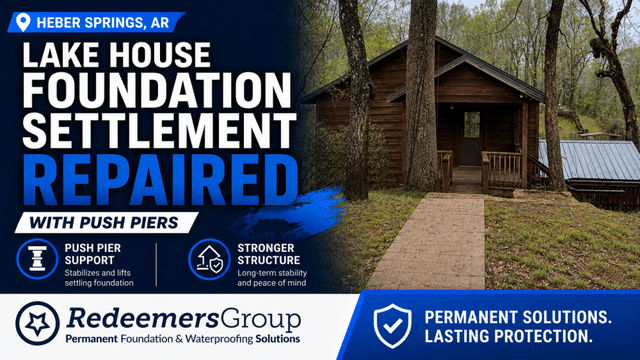
When a lake house is built on the side of a hill, foundation movement can become more than a cosmetic concern. Sloped properties near the water are often exposed to changing soil conditions, erosion pressure, and settlement that can cause cracks, uneven floors, and structural movement over time.
That was the situation at a lake house in Heber Springs, Arkansas, where the rear foundation and second-floor overhang were settling toward the water. The home needed more than a patch or surface repair. It needed a foundation stabilization plan designed to address the movement at the source.
Foundation Settlement Problem at a Heber Springs Lake House
The homeowner, Casey S., purchased the Heber Springs lake house in 2025. The property is located next to his mother’s home, making it an important long-term investment for the family. Before Casey purchased the home, the previous owner had already noticed concerns along the back side of the foundation.
The most visible sign of trouble was cracking in the downstairs flooring. These cracks had been increasing over time, which is often a warning sign that the foundation is continuing to move rather than simply showing old damage.
In this case, the settlement was occurring toward the water. Because the home sits on the side of a hill leading down to the lake, the rear foundation was under added stress from the slope, soil movement, and elevation change.
Common Signs of Foundation Settlement in Lakefront Homes
Lakefront and hillside homes in Arkansas can develop foundation problems when the soil beneath or around the home shifts, washes out, compresses, or fails to provide consistent support.
Homeowners should watch for signs such as:
- Cracks in tile, concrete, or downstairs flooring
- Uneven or sloping floors
- Gaps around walls, trim, windows, or doors
- Movement near decks, porches, or overhangs
- Foundation cracks along the downhill side of the home
- Visible soil loss or erosion near the foundation
- Structural supports or pillars that appear to be settling
At this Heber Springs home, the cracking floor and rear foundation settlement indicated that the structure needed permanent stabilization.
Why the Second-Floor Overhang Needed Foundation Support
One important part of this project was the home’s second-floor overhang. The second floor extended approximately four feet beyond the lower level and was supported by a large span beam and two pillars, one on each side.
Those pillars sat on concrete supports that appeared to be approximately 24 inches by 24 inches. Because the overhang was settling in line with the main foundation, the repair plan needed to stabilize both the rear foundation and the support points beneath the second-floor overhang.
This matters because an overhang places weight on specific load-bearing areas. If the supporting pillars settle, the structure above can shift, sag, or become uneven. Stabilizing only the main foundation without addressing the pillars would leave part of the problem untreated.
The Recommended Foundation Repair Solution
The proposed repair plan included:
- Installing 11 push piers around the rear of the home
- Installing 1 push pier beneath each second-floor support pillar
- Using PolyLevel polyurethane foam injection to stabilize and lift the interior slab
- Backfilling voids with polyurethane foam to improve support beneath the home
- Filling injection ports with crack filler after the PolyLevel work was completed
Because Casey was already planning to replace the raised wooden deck, he agreed to remove the necessary portions before the foundation repair crew arrived. He also planned to replace the affected flooring, so the injection ports through the tile were not a concern.
Push Pier Installation for Foundation Stabilization
Push piers are used to stabilize settling foundations by transferring the weight of the structure from unstable surface soils to deeper, more competent load-bearing soil or strata.
For a home on a slope near the water, this is especially important. Surface soils can be more vulnerable to erosion, moisture changes, and movement. Push piers help bypass those unreliable soils and provide a more stable support system beneath the foundation.
At this Heber Springs lake house, push piers were installed along the rear foundation and beneath the two second-floor support pillars. The goal was to stabilize the structure and, where possible, lift settled areas back toward a more level position.
Challenging Conditions: Crumbling Foundation and Shallow Footer
During installation, the crew discovered that the foundation was in worse condition than expected. Shortly after beginning work, they found that parts of the foundation were crumbling badly enough that pieces could be removed by hand.
After inspecting farther down the wall, the same condition was found along the foundation. This was an important discovery because foundation repair is not just about installing piers; the existing structure must be strong enough to transfer loads safely.
The crew discussed the issue with the homeowner and reviewed the available options. Casey chose to continue after arranging for concrete work.
Later installation notes also showed that the soil was fairly soft and the footer was very shallow, sitting close to the top of the ground. Because the home is located on the side of a hill, these conditions made careful installation and controlled lifting even more important.
Why Controlled Foundation Lifting Matters
Foundation lifting is not about forcing a house upward at all costs. It is about safely recovering movement where possible while protecting the structure from additional damage.
During this project, the house began lifting at approximately 2,000 psi. The crew achieved a noticeable amount of lift, but some piers were left pressurized between approximately 1,200 and 1,500 psi.
The homeowner wanted additional lift in certain areas, but the crew made the right call by stopping where they were no longer comfortable continuing. That decision matters.
When a foundation has crumbling concrete, shallow footers, hillside conditions, and existing structural stress, pushing too hard can create new damage. A responsible foundation repair approach prioritizes stabilization first, with lift attempted only where it can be done safely.
PolyLevel Foam Injection for Interior Slab Stabilization
After the push pier work, the crew returned to perform PolyLevel foam injection. Holes were drilled through the interior slab, and high-density polyurethane foam was injected beneath the floor.
PolyLevel is designed to expand beneath the slab, filling voids, stabilizing loose areas, and lifting settled concrete where possible. On this project, the crew was able to achieve lift from all drilled injection points.
They also sprayed PolyLevel into voids around the house at the customer’s request. After the injection work was completed, all holes were filled with crack filler.
Why PolyLevel Was Important for This Lake House Repair
The push piers addressed the foundation settlement, but the interior slab also needed support. Cracks in the downstairs flooring were a sign that the slab had been affected by movement below.
PolyLevel helped support the interior slab by filling empty spaces beneath it. This is important because unsupported concrete can continue to crack, sink, or shift, even after the foundation walls are stabilized.
For homeowners, this is the key lesson: foundation stabilization and concrete slab stabilization often need to work together. If the structure and slab are both affected, treating only one part may not fully solve the problem.
Foundation Repair on Hillside and Lakefront Properties in Arkansas
Homes near lakes, rivers, and steep slopes can face unique foundation challenges. The soil may move downhill over time, become saturated after heavy rain, or lose support near the foundation. Large rocks placed near the base of a slope can help hold soil in place, but they do not always prevent settlement beneath the home.
This Heber Springs property had several conditions that made professional foundation repair especially important:
- The home was built on the side of a hill
- The rear foundation was settling toward the water
- The soil was soft in areas
- The footer was shallow
- The existing foundation showed crumbling concrete
- The second-floor overhang depended on properly supported pillars
- The interior slab needed void filling and stabilization
These are not conditions that should be handled with temporary patching or cosmetic repairs. They require a structural solution designed to stabilize the home.
The Result: Stabilized Foundation and Supported Interior Slab
By combining push piers and PolyLevel, the repair plan addressed both the foundation settlement and the unsupported interior slab areas.
The push piers helped stabilize the rear foundation and second-floor support pillars. The PolyLevel foam helped fill voids and stabilize the slab from below. The crew achieved lift during both phases of the project while also making careful judgment calls to avoid pushing the structure beyond a safe point.
For this Heber Springs homeowner, the project helped protect a lake house investment and prepared the home for future deck and flooring replacement.
Why Homeowners Should Not Ignore Foundation Settlement
Foundation settlement usually gets worse when the underlying cause is not addressed. Cracks in flooring, movement near decks, and settlement along the downhill side of a home can all point to soil or structural support problems.
The longer a homeowner waits, the more complicated the repair may become. Flooring, framing, decks, walls, and support columns can all be affected when foundation movement continues.
A professional inspection can help determine whether the home needs foundation piers, slab lifting, soil stabilization, drainage improvements, or a combination of solutions.
Call Redeemers Group for Foundation Repair and Concrete Lifting in Heber Springs, AR
If you are seeing cracks in your floors, uneven concrete, settlement near a lake-facing foundation wall, or movement around a deck or overhang, schedule a professional inspection with Redeemers Group.
Our team can evaluate your home, explain what is causing the problem, and recommend the right solution for foundation stabilization, push pier installation, PolyLevel concrete lifting, and slab support.
Contact Redeemers Group today to schedule your foundation repair inspection in Heber Springs, AR, and protect your home from continued settlement.